


The Unified Governance Continuum (UGC) is an operating environment, not an organization. It defines an ecosystem within which distinct, interoperable actors operate with clearly separated mandates: values, strategic intent, standards definition, stewardship, certification, and real-world application. Authority is distributed, legitimacy is earned, and adoption is voluntary but consequential.
Standards are treated as living artefacts. They evolve through structured feedback from practice rather than remaining static declarations. The system is designed to remain neutral, auditable, and resilient beyond individual organizations, funding cycles, or political conditions.
UGC is the ecosystem in which the UGA can mature into a global framework of standards.
The Continuum is constructed around strict separation of mandates. No actor holds authority across values definition, standards intent, operational stewardship, certification, adoption, or capital allocation. Each role is bounded, independently legible, and non-substitutable.
This separation is not organizational preference but systemic constraint. It prevents capture, reduces conflicts of interest, and ensures that legitimacy, auditability, and trust emerge from structure rather than reputation, alignment, or informal coordination.
By enforcing separation at the role level, the Continuum remains resilient under scale, personnel change, institutional turnover, and political pressure. Authority is exercised where it is appropriate, and nowhere else.
The Continuum is structured as a closed-loop system spanning the full standards lifecycle. UGSO provides operational continuity, maintaining coherence as standards progress from intent through application, validation, and maturation.
Normative inputs, standards, initiatives, certification, adoption, and capital interface through structured feedback grounded in practice. Procedures and safeguards are introduced in stages, enabling system evolution without compromising legitimacy, auditability, or structural integrity.
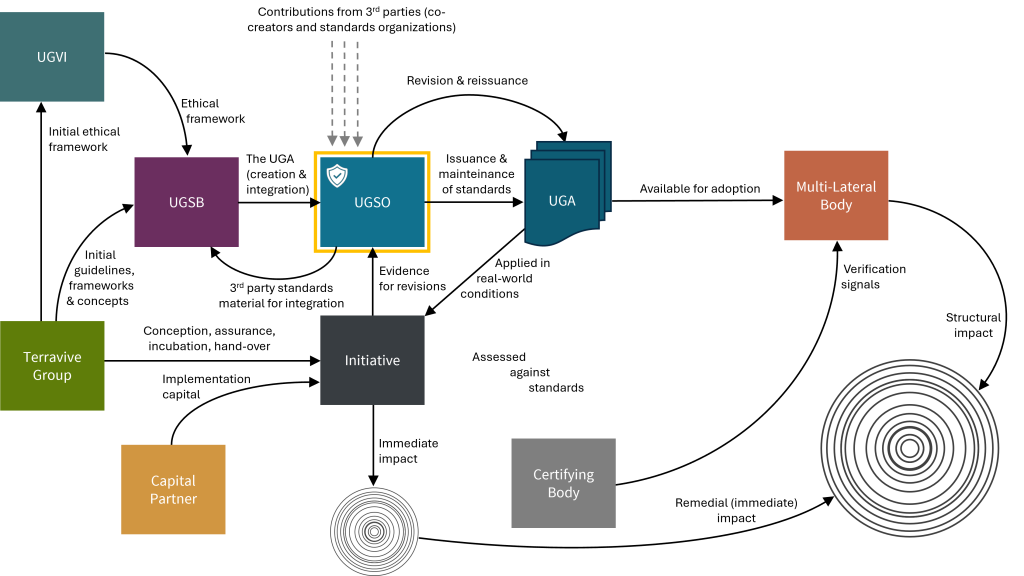
This is a constitutional diagram, not an operational one. Certain roles are currently provisioned through interim arrangements. If an actor, role, or process is not represented here, it is not part of the Continuum.
Unified Governance Systems Organization
Great Portland Street, 167-169
5th floor, London W1W 5PF
United Kingdom
Copyright © Unified Governance Systems Organization 2025. All Rights Reserved.
Companies House reg. no. 16890535